
How Cross-Docking Services Can Reduce Warehousing and Distribution Costs
Cross-docking services can help businesses reduce warehousing expenses, minimize inventory handling, and move products to customers faster. For manufacturers, distributors, and retailers, this logistics strategy can make financial sense when products need to move quickly rather than sit in storage.
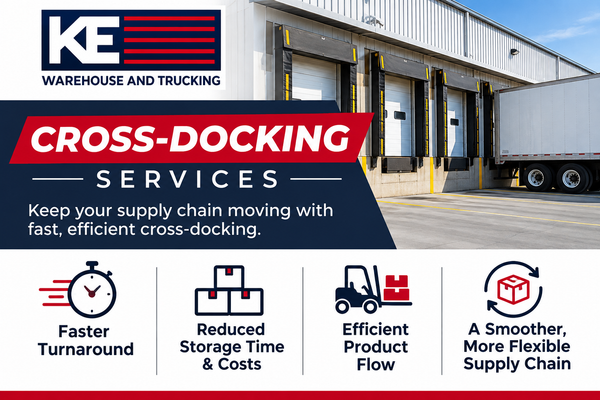
Traditional warehousing involves receiving merchandise, placing it into storage, managing inventory, and retrieving products when orders are ready to ship. Each step requires labor, equipment, warehouse space, and time.
Cross-docking takes a different approach. Instead of storing products for extended periods, incoming shipments are transferred to outgoing trucks with little or no storage time between deliveries.
For businesses managing frequent shipments or distributing products across multiple locations, eliminating unnecessary storage can create meaningful cost savings.
K.E. Warehousing & Trucking (KEW) provides cross-docking services in Cincinnati, Ohio, helping businesses coordinate incoming freight, organize shipments, and move merchandise efficiently throughout the Midwest.
What Is Cross-Docking, and How Does It Work?
Cross-docking is a logistics process that moves products from incoming transportation directly into outbound distribution with minimal time spent in warehouse storage.
For example, a manufacturer may ship a full truckload of merchandise to a Cincinnati distribution facility. Rather than unloading the products into long-term storage, the warehouse team separates the shipment according to its final destinations. Some pallets may be loaded onto a truck heading toward Dayton, while others are prepared for deliveries in Northern Kentucky, Indianapolis, or other regional markets.
This approach allows businesses to consolidate shipments, organize regional deliveries, and avoid unnecessary storage expenses. Cross-docking is particularly effective when shipment schedules are coordinated and the destination of the merchandise is already known. However, cross-docking is not the best solution for every shipment. Products that require extended storage, extensive preparation, or unpredictable fulfillment schedules may be better suited for traditional warehousing.
The decision should depend on the type of merchandise, shipment frequency, delivery requirements, and overall transportation costs.

When Does Cross-Docking Save Your Business Money?
The financial value of cross-docking comes from reducing unnecessary steps between receiving merchandise and delivering it to the next destination.
When implemented correctly, businesses may spend less on storage, warehouse labor, inventory handling, and transportation coordination.
Several situations make cross-docking particularly attractive:
- High-volume shipments: Businesses receiving large quantities of merchandise can move products through a distribution facility without paying for extended storage.
- Predictable customer orders: When products already have assigned destinations, freight can be sorted and prepared for outgoing deliveries immediately.
- Multiple regional deliveries: Cross-docking can consolidate incoming freight and organize outgoing shipments for several customers or locations.
- Time-sensitive merchandise: Products with short delivery windows may benefit from spending less time in storage.
- Limited warehouse space: Manufacturers and distributors can avoid filling valuable production or storage areas with inventory that is ready to ship.
- Seasonal demand: Businesses experiencing temporary increases in shipping volume may use cross-docking to manage merchandise without expanding permanent warehouse capacity.
Understanding the Actual Cost Savings
Consider a distributor receiving 100 pallets of merchandise that must be delivered to several retail locations within the next few days.
With traditional warehousing, those pallets might be unloaded, entered into inventory, placed into storage racks, retrieved, staged, and loaded onto outbound trucks. Each additional activity creates labor and equipment expenses. The business may also incur storage charges based on the number of pallets and the time they remain in the warehouse.
With cross-docking, the same merchandise may be unloaded, sorted, staged briefly, and transferred directly to outgoing trucks.The business avoids some of the storage and handling activities associated with traditional warehousing. However, cross-docking still involves costs. Freight receiving, sorting, staging, loading, transportation, and scheduling all require resources.
The financial question is whether the savings from reduced storage and handling exceed the additional coordination and transportation expenses. Businesses should compare their total logistics costs rather than focusing only on warehouse storage rates.
When Is Traditional Warehousing a Better Financial Choice?
Although cross-docking can reduce operating expenses, there are situations where traditional warehouse storage provides better value.
For example, a manufacturer importing components for production over the next six months may need reliable inventory storage rather than immediate distribution. Similarly, a retailer purchasing seasonal merchandise well before customer demand begins may benefit from storing products until orders increase.
Cross-docking can also become expensive when inbound shipments arrive late, outgoing trucks are unavailable, or merchandise requires unexpected sorting and handling. Poorly coordinated shipments may create additional labor expenses, transportation delays, and temporary storage requirements.
Businesses with unpredictable customer orders may find that conventional warehousing offers more flexibility because merchandise remains available for future fulfillment.
Compare Total Logistics Costs Before Making a Decision
When evaluating cross-docking, consider the complete cost of moving products through your supply chain. Storage expenses are important, but transportation rates, shipment frequency, labor, product handling, and delivery schedules can have an even greater impact on profitability.

For some businesses, the most practical solution is a combination of cross-docking and short-term warehouse storage. Products with confirmed delivery destinations can move directly through the facility, while merchandise awaiting orders or transportation can remain in storage. This flexible approach helps businesses avoid forcing every shipment into the same logistics process.
A third-party logistics provider with both cross-docking and warehousing capabilities can help businesses evaluate which approach makes the most financial sense for different types of freight.
Cincinnati Cross-Docking Services From K.E. Warehousing & Trucking
Choosing the right logistics partner is an important part of making cross-docking financially worthwhile.
K.E. Warehousing & Trucking has served businesses throughout Greater Cincinnati since 1988, providing warehouse storage, trucking, distribution, and third-party logistics services.
Located at 3710 Jonlen Drive in Cincinnati, Ohio, KEW offers convenient access to major transportation routes serving Ohio, Kentucky, Indiana, and the surrounding Midwest. KEW’s cross-docking services help businesses receive incoming shipments, sort or consolidate merchandise, and prepare products for outgoing transportation.
The company also provides local and regional trucking, container unloading, inventory management, and short-term warehouse storage. Having these services available through one logistics partner can simplify communication and reduce the coordination required between separate warehouse and transportation providers. For manufacturers and distributors, this can be particularly valuable when shipments need to move between production facilities, suppliers, distribution centers, and customers.
KEW understands that reducing logistics costs involves more than moving freight quickly. Accurate handling, dependable communication, and flexible scheduling all contribute to an efficient supply chain.
Frequently Asked Questions About Cross-Docking
Does cross-docking eliminate warehouse storage costs?
Cross-docking can reduce or eliminate the need for long-term storage for qualifying shipments. However, businesses may still incur receiving, handling, staging, and transportation charges.
Is cross-docking cheaper than traditional warehousing?
It can be, especially when products have known destinations and can move quickly between incoming and outgoing trucks. The actual savings depend on shipment volume, handling requirements, transportation costs, and scheduling.
What types of businesses benefit from cross-docking?
Manufacturers, wholesale distributors, retailers, freight brokers, and companies managing frequent regional deliveries may benefit from cross-docking services.
Can cross-docking and warehouse storage be used together?
Yes. Businesses can use cross-docking for merchandise ready for immediate distribution while keeping other products in short-term or long-term storage.
Does KEW offer cross-docking and trucking in Cincinnati?
Yes. K.E. Warehousing & Trucking provides cross-docking, regional transportation, warehouse storage, and additional logistics services for businesses throughout Cincinnati and the surrounding region.
Find Out Whether Cross-Docking Can Reduce Your Logistics Costs
Are you paying to store merchandise that could be moving directly to customers?
K.E. Warehousing & Trucking can help you evaluate your shipping and distribution needs and determine whether cross-docking, traditional warehousing, or a combination of services is appropriate for your business.
Our Cincinnati team works with manufacturers, distributors, and other businesses seeking practical ways to manage freight, control operating expenses, and improve distribution efficiency.
Call KEW at 513-272-3222 or visit kewarehouse.com to request a warehousing and logistics quote.
